Monday, February 17, 2014

The Snow Moon and the Spring to Come

Snow moon at Wellspring, 2/14/14
This weekend began with a Snow Moon on Friday night. Some Native American tribes call the February full moon "the Snow Moon" because it was often the time when the greatest amount of snowfall came.  The weekend following the full moon was another that offered below 20 degrees by day and single digits at night. Admittedly, the colder temperatures this winter have been hard to handle. I love all the snow, but these very cold temps appear to be the new "normal" (what's normal anyway?) and it's been hard to accept that. The cold challenges our ability to stay warm in the poorly insulated tent we call home; it tests our water system and the resilience of our cheeks, fingers and toes (thank god for wool, fleece and down!)

Yet last night, as I reflected upon the week prior, I felt a soothing exhaustion within my muscles. I lay under a blanket with my 2 pups while the wood stove radiated warmth both as temperature and as light.  And my entire being was at peace.

Sadie (now with a GPS collar!)
The week started with a ski trip to Tug Hill. A wonderful snowy weekend, just the 4 of us, until Sadie ran away on our second ski of the day. She was missing for hours. It was dark. It was snowing, and of course, it was cold.  Losing hope, at 6:10pm I asked my friends to pray for her. At 6:11 I was crying. At 6:20 I met Steve at our agreed meet-up spot. And Sadie was there too.
It was nothing short of a miracle.


Sunlit woods CT Hill
This whole week (though still cold) gifted us brilliantly sunny skies, crisp clean air and snow as soft as sifted powered sugar.  The x-country skiing is magical right now and it's the perfect way to get outside and stay warm no matter how cold.

On Sunday morning we went for a 3 hour ski. Then spent 3 hours trudging through the snow with the help of our neighbors to tap ~100 sugar maple trees on our land. A short thaw is coming Tuesday, and we're now ready to harvest the sugary gift of winter.

Metal maple buckets
Sure, the cold can make us all pretty cranky. It certainly makes duck chores less enjoyable, and the second time our water froze - this time it's frozen until the spring thaw -  I really thought I was ready to give up on our lifestyle. But as I reflect on the winter, it has been one of lessons learned and always something to be grateful for if we look for it. (Steve figured out a backup system so we still have water - stay tuned for that blog post).  I now can surrender to winter and I welcome it's force, it's softness and it's gifts.

The Snow Moon also represents the coming of spring. It’s the time when the seeds start stirring to life under the cold ground. The farmers are planning for the season. The animals are readying for their spring births and we are reminded that the long winter will not be here forever.
 ~~~

The Peace of Wild Things - Berry  

When despair for the world grows in me
and I wake in the night at the least sound
in fear of what my life and my children’s lives may be,
I go and lie down where the wood drake
rests in his beauty on the water, and the great heron feeds.
I come into the peace of wild things
who do not tax their lives with forethought
of grief. I come into the presence of still water.
And I feel above me the day-blind stars
waiting with their light. For a time
I rest in the grace of the world, and am free.

Friday, February 14, 2014

Grandpa is here, on the farm.


Valentines day has always seemed to be a fabricated holiday to me - like many holidays in the US it has it's roots in tradition and yet has become all too commercialized. The day - Feb 14 - has more meaning to me because it is the shared birthday of my grandparents, Fred and Ruby Bergschneider. This coincidence is fitting because for much of my life they have been the example of genuine love, something they shared with each other and their large family.

me (high school) with grandpa (in coveralls) & grandma
Grandpa passed away in 2008. This year, my grandmother turns 85, and grandpa would have been 88. He had a hard battle with Parkinson's in his latter years which was especially difficult for him because so much of what defined grandpa was mobility and thought; he was by far the hardest working man I knew; often up before the sun and working long into the evening, when he'd close up the coin laundry he ran with grandma and come home to fall asleep in his big easy chair.

Grandpa loved to work, loved to farm, loved being outside, and loved helping people. He was an engineer for the Marines in WWII, returning to marry my grandmother and start a family. He got into farming first as a hired man and then farmed for many years in Waverly Illinois, raising beef cattle, pigs, corn, beans, and wheat, and grew lots of their own food in gardens. The whole family, which included 8 brothers and sisters have a range of stories about their time on the farm.

At the farm here, Grandpa is everywhere. I can't help but think of him often as I putter about, taking care of fixing this broken pipe or troubleshooting a problem. His ethic, one important to my father, was that it was better to take a bit longer but do the job right, to the fullest. Also strong in me is a willingness to think hard on a problem, racking my brain and trying to come at it from many different angles. Collaboration and teamwork was also key; something my dad and I do all the time; spending long hours on the phone diagnosing problems, a pattern my father and grandfather often did.

In many ways Fred was my father's best friend. The relationship grew from a mutual interest in electronics, construction, and working with you hands. My grandfather become a healing force in my dads life; his father had been the polar opposite of a loving, supporting person in his life. Besides my grandmother, I think my dad spent the most time with Fred out of anyone in the family - mostly because grandpa was always out working on this or fixing that. They two formed a strong bond and when grandpa passed away it hit my father really hard. Grandpa was a big part of my fathers healing from an abusive childhood, and Fred was able to be both a father and a friend.

the water-moma.
When I lose someone from this world I often commit to serving in their image as I go about my work. As I've gotten into farming and working with the land, my dad and I have continued the working relationship he had with grandpa and we've worked on many projects that grandpa would have loved to help with. My dad and grandpa worked on a unique project long ago in Illinois - an automated monitor that ensure that grain in storage would not get too humid and thus go bad. This invention made grandpa a valued local member of the farming community long after he stopped farming himself. He (and my father) continued to fix electronic farming equipment for many years.

The grain-monitoring invention was named "Grain-Moma" with the idea that the device watched over the grain much like a mother watching over her children. In this image my father and I have developed many things for the farm here including the duck-moma (automatic duck door), pump-moma (shuts off a small DC pump when a tank runs dry) and water-moma (flashes a red light when our rainwater tank is low). Since I interact with these on a daily basis, I am constantly reminded of him, and of the working relationship of father and son that I value as much as my father and Fred did.


In the colder winter months many mornings I am called out into the cold to care take for the animals, letting them out and bring fresh water and food to their troughs. Many of these mornings I slip on a pair of coveralls - more or less an insulated body suit which keeps one super warm. I got my first set of coveralls when I was 6 or 7, wanting to be like dad and grandpa who I always saw wearing them. At that age I used them to keep warm while sledding or building a snow cave. Now it's a necessity to keep up with farm chores and spend long stints outside boiling sap or moving things around. I remember grandpa once saying that all you need to keep warm is a hooded sweatshirt and coveralls. I remember this every time I get ready to go outside.
coveralls.

Another time I remember him is when I put on a button-down farm shirt as a layer and inevitably find myself stuffing screws, receipts, and other random items in the breast pocket. This was grandpas signature wardrobe item; always with one (or both) pockets stuffed full of notes, papers, glass cases, and who-knows-what. I was always amazed at how much he was able to fit in there without it all spilling out.

The final time I think of grandpa (and grandma) is each summer when we put food into storage - especially corn. Illinois after all is part of corn-central USA, and one of my grandpas strategies during the summer was to order a truckload (literally) of sweet corn when all the grandkids were around and we'd help shuck it before it was cut of the cob and put in bags for freezing. Grandpa always had a task for a willing person to do and I was always up to help - I loved sitting on his lap and mowing the fields with the old tractor. I loved holding tools and helping weed in the garden. To spend any meaningful time with him, you had to be willing to work on a project. That was what he did with his time, day in and day out.

a place to remember our ancestors in our home.
As Liz and I build our ideal farm and homestead we are in many ways returning to a sense of life that was a necessity for many people in our grandparents generation. We return from choice, both because we enjoy the lifestyle and because we love knowing where our food comes from. I like to think that if grandpa was alive and able these days he would come out to OUR farm and help us with OUR projects. And he'd love it.

So, Grandpa is here on our farm, to stay. As we go about our lives Liz and I try our best to hold and remember the wisdom and love we experienced with our deceased grandparents Fred, Martin, Annette, and Irene. We live in the passion and the moment as we witnessed in Dale Bryner, Collin Anderson, and Chris Dennis. And as we do this we hold the idea that these people who have left the world as we know it can live on forever in the way we live; that we can remember their gifts and bring them into our daily existence.


Happy Birthday to my Grandpa Fred and Grandma Ruby!


Wednesday, January 29, 2014

Audio recording of a talk on maple sugaring from 1.14.13 and reminder of Maple Sugaring Workshop THIS weekend, Feb 2.

Steve was honored to be asked to present at the historic Montour Falls Library in January of 2014, where he talked about his experience with maple sugaring on a variety of scales and covered the basics of tapping, harvesting, boiling, and storing maple syrup. Many thanks to Shelly Schlueter for the recording. 


Resources recommended in the talk:

The Maple Sugar Book by Helen & Scott Nearing
A classic text that provides a great read on the history, lore, and experience of these famous Maine and Vermont homesteaders. The Nearings sugared as the primary means of income generation to support their simple homestead lifestyle.

Backyard Sugarin’ By Rink Mann & Daniel Wolf
A great read for the basics of small scale sugaring operations. Great examples of homemade sugaring set ups, and many tips for the beginning.

The Sugarmakers Companion By Mike Ferrell
This book is the most up-to-date, comprehensive book on sugaring out there. Just released in 2013, the author (who is director of Cornell’s maple research program, details all the latest research and important steps in sugaring including marketing tips. An absolute must for commercial sugarmakers.

CLICK HERE for a recent North Country Public Radio interview with Mike


Also see this post: Backyard Sugaring the Permaculture Way written by Steve in 2013.


....and a reminder:


BACKYARD MAPLE SUGARING WORKSHOP
Sunday, February 2nd 

Mecklenburg NY

1pm - 4pm


If you've ever considered tapping a few trees in the backyard, collecting the sap, and making your own maple syrup, Wellspring Forest Farm invites you to a workshop on the basics of small-scale maple syrup production.

We will cover the basics of tapping, collection, boiling, and finishing of sap and syrup. In addition to sugar maples, black walnuts and birches can be tapped and this potential will also be discussed. 

The workshop will take place on farm and includes a tour of the small sugarbush of about 100 trees (hopefully we will be boiling!). The class will be led by Steve Gabriel, who has been sugaring for almost ten years on a range of scales from 5 to 500 trees. The cost for the class is $10 per person.

USED MAPLE BUCKETS FOR SALE

We have limited quantity of high quality metal bucket sets for sale. These are increasingly hard to find. For $15 you get a bucket, lid, spout, and tap along with basic instructions. If you get buckets and pick them up Feb 2, the class fee (below) will be waived. Buckets are available on an ongoing basis.


To register, fill out the form below. Questions? Email sfg53@cornell.edu or call 607.342.2825. 

Tuesday, January 21, 2014

Thoughts on an eighth year sugaring in New York

Join us at Wellspring Forest Farm for a backyard sugaring workshop on SUNDAY, FEBRUARY 2 from 1 - 4pm. We also have maple bucket sets for sale. SEE MORE DETAILS HERE.

Sugarbush @ Sapsquatch Maple Products
Time is a funny thing, and reflecting on eight years of sugaring feels at once like very little and also lot. When I think about taking part in a practice that humans have been doing for hundreds of not thousands of years here in the Finger Lakes, my experience is but is split second. In the context of a singe lifetime, though, it adds up to something more significant.

I started my first year with just 25 trees at the Cayuga Nature Center, where the main focus was education for school and youth groups in the area. My favorite event of the year was MapleFest, which had been going on a the center for more that 40 years during my tenure and attracted hundreds of visitors. Working at this place brought me full circle, as I'd first tapped a tree and tasted sap as a seven-year-old, one of the experiences that began my interest in natural systems at a young age.

From the nature center I joined Josh Dolan at Sapsquatch Maple Products in Enfield, NY, tapping around 500 trees for several seasons and having a go at the "big time" of commercial production. Here we worked hard, slept very little, and pushed everything to its potential. I am glad Sapsquatch is still going strong, through I personally chose to scale back down and for a few years tapped just a few trees in my backyard. With the new farm purchased just last year, we now have our version of perfection; a small, healthy grove of maples that offers about a 100 trees which we tap and boil in the woods, at home.

Entering this season, I took a moment to look through all my past photos and pulled a few to share, along with some anecdotes and stories of my time with sugaring. Here are my three favorite reasons that I come back to sugaring season after season:


1#: The art of sap drinkery


Examples of enthusiastic "sap faces" from left to right: Sirena Carpenter, Josh Dolan, and Anya Korfine


One of my favorite aspects of working on all of these operations has been sharing this process with youth, which connects them to the powerful cycles of nature. There is no better way to get a child excited about nature then to show them that sugar can come from a tree! This was my primary experience, and one that I've loved sharing with others, most often for several years as a mentor at EarthArts. Working with kids here earned me one of my favorite nicknames, “Sugarman Steve.”

On a good day, the sap flows like a faucet

These kids knew how to drink sap. We never boiled any, as it was all consumed "raw" and occasionally as a base for white pine needle tea which we'd cook over a fire. There is much virtue in just tapping a few trees for the sap alone; it is a pure and clean beverage (think about it; what could be more filtered than water from a tree?) that boasts high amounts of calcium, potassium, magnesium, iron, and zinc. Some companies even bottle and sell sap drinks.
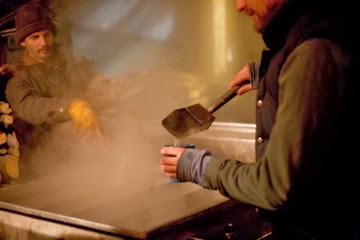


making a sap + whiskey to fight the chills
 The water can be enjoyed alone or as a great base for tea and hot beverages. When partially boiled to increase concentration it can be mixed with carbonated water for an all-natural sap-soda. In South Korea, drinking sap is of the utmost importance, where it is considered a "tree good for the bones" and used in a fascinating detox ritual involving a hot room, salty snacks, and lots of sap drinking. Of course, many can attest that the best way to enjoy sap is around the boiler itself, warmed on the fire, with a bit of whiskey added to warm your bones on a cold night.


#2: Sugarshack culture

Good music helps pass the time during a boil
The second best part of sugaring is that the inevitable long hours required for boiling is a great time to invite cold-hardy friends over to have a party around the fire. February and March, the normal peak of sugaring season, is for many people a time when cabin fever is really setting in, and an excuse to get outside is greatly welcomed. One particularly special night for boiling is the "sugar moon", or the full moon that occurs during the sugaring season that is considered the first full moon of spring. This year it falls on March 16th.

There is something about a long night spent out in the cold woods yet standing around a warm fire with plenty of hot beverage and the hum of the boiler that feels timeless, offering a chance to slow down and appreciate the world around you. The fact that syrup requires so much attention is a constant reminder that the products of nature come only with patience, precision, and care. Sugaring specifically is a practice that is only found in the northern cold temperate hemisphere on earth, which makes it a unique process married to both time and place.

Emily Meacham stokes the Sapsquatch fire. 

For those times that friends can't come around the boil, I try to catch up on some reading as I stoke the fire. Some favorite sugaring books are:

The Maple Sugar Book by Helen and Scott Nearing -- A classic text that provides a great read on the history, lore, and experience of these famous Maine and Vermont homesteaders. The Nearings sugared as the primary means of income generation to support their simple homestead lifestyle.

Backyard Sugarin’ by Rink Mann & Daniel Wolf -- A great read for the basics of small scale sugaring operations. Great examples of homemade sugaring set ups, and many tips for the beginning.

The Sugarmakers Companion By Mike Ferrell -- This book, just out in Fall 2013, is the most up-to-date, comprehensive book on sugaring out there. Just released in 2013, the author (who is director of Cornell’s maple research program, details all the latest research and important steps in sugaring including marketing tips. An absolute must for commercial sugarmakers.


#3: Time in the waking woods

Dripping spouts are a metronome marking the coming of spring
The best part of sugaring overall is the "excuse" to spend many hours in the woods, witnessing the slow transition of winter to spring, which many years looks more like a boxing match, with the warm spells offering a glimmer of hope and the sudden cold snaps taking any sign of spring away in an instant. Truth be told, for the aspiring sugarmaker, the best seasons are those that flip flop often, though not if the temperatures get too warm (over 45 degrees F) for too long.

While the transition from summer to fall is quite dramatic in these parts, with leaves changing from green to an array of brilliant colors, the signs of winter to spring are more subtle. Walking by buckets and hearing the slow tap-tap-tap of the sap means the trees are moving slow, while on the warmer days the drops fall almost one after the other. Coupling these observations with the larger weather patterns; the wind, the stillness, the sun, the clouds, all tell a unique story and provide a picture show better than any movie or television. The sunsets are often dynamic in purples, blues, and deep reds, while the sunrises offer oranges and yellows which welcome and encourage a weary sugarmaker that another day has arrived, one more day closer to spring.


On the wall of a sugarshack in Eastern NY
Join us at Wellspring Forest Farm for a backyard sugaring workshop on SUNDAY, FEBRUARY 2 from 1 - 4pm. We also have maple bucket sets for sale.

SEE MORE DETAILS AND SIGN UP HERE.

For more reading on the "how-to" of sugaring, check out this piece Steve wrote for the book he is co-authoring, Farming the Woods
.


Tuesday, January 14, 2014

Maple Sugaring Workshop 2/2/14 & Buckets for Sale


Sunday, February 2nd
Mecklenburg NY
1pm - 4pm


If you've ever considered tapping a few trees in the backyard, collecting the sap, and making your own maple syrup, Wellspring Forest Farm invites you to a workshop on the basics of small-scale maple syrup production. We will cover the basics of tapping, collection, boiling, and finishing of sap and syrup. In addition to sugar maples, black walnuts and birches can be tapped and this potential will also be discussed.

The workshop will take place on farm and includes a tour of the small sugarbush of about 100 trees (hopefully we will be boiling!). The class will be led by Steve Gabriel, who has been sugaring for almost ten years on a range of scales from 5 to 500 trees. The cost for the class is $10 per person.

USED MAPLE BUCKETS FOR SALE
We have limited quantity of high quality metal bucket sets for sale. These are increasingly hard to find. For $15 you get a bucket, lid, spout, and tap along with basic instructions. If you get buckets the class fee will be waived. If you can't make the class, individual pick-up or delivery can be arranged in the Ithaca/Trumansburg/Watkins Glen area.

Wednesday, October 16, 2013

Get our Duck Eggs at the Piggery!


Our Khaki Campbell's are starting to lay and we want to share the harvest. Starting October 18th our duck eggs will be available at the Piggery in Ithaca!

Duck eggs have about twice the nutritional value of a chicken egg and stay fresher longer due to their thicker shell. The yolk is a richer flavor with more albumen, which makes cakes and pastries fluffier and richer. They are an Alkaline producing food, one of the few foods that leave your body more alkaline which is a great benefit to cancer patients as cancer cells do not thrive in an alkaline environment. (Chicken eggs are an acid food leaving your body more acid.)

Our Khaki Campbell layers are wonderful foragers and reliable egg producers. Under the careful watch of Gilbert the goose, they enjoy most of their time foraging for pests (and the occasional salad green) in our gardens on the farm. They are supplemented with high-quality feed.

Thursday, October 10, 2013

Our duck meat available at the Piggery!

Local, pasture and forest raised ducks are available from Wellspring Forest Farm in Mecklenburg, NY starting THIS EVENING at the Piggery (http://www.thepiggery.net/) in Ithaca. A very LIMITED supply to get down there ASAP!

The ducks were rotated weekly through our fields and forests and feast on bugs and slugs as well as high quality grain. These are Rouen which are an listed as an "watch list" heritage breed duck by the American Livestock Breeds Conservancy and feature a dark, rich flavored meat. These smaller ducks are the perfect delicacy of a meal for two people.

GRATITUDE for the lives lost to sustain us all.